
Dr. Giovanni Scornavacca
26 June 2026 · 25 min read
Medically reviewed by Dr. Giovanni Scornavacca — Hair Restoration Specialist, Carisma Hair Clinic, St Julian's, Malta. 20+ years clinical experience, trained in Rome and Bologna.
Medically reviewed by Dr. Giovanni Scornavacca — Hair Restoration Specialist, Carisma Hair Clinic, St Julian's, Malta. 20+ years clinical experience, advanced training at universities in Rome and Bologna.
Norwood Scale Malta: Which Stage Are You?
The Norwood scale is the standard clinical classification system used by hair loss specialists to assess the degree of male androgenetic alopecia. It divides hair loss into seven primary stages — from Stage I, where no meaningful recession has occurred, to Stage VII, where only a narrow band of hair remains at the sides and back of the scalp. Accurate staging in Malta determines what treatments are appropriate, what outcomes are realistic, and whether medical therapy alone is likely to be sufficient.
There is a particular moment that most men describe in the same way. They are standing under a bright light — a hotel bathroom, a colleague's office, a phone camera showing the back of their head — and the angle is slightly different from what they usually see. The recognition is immediate and private. The question that follows, just as privately, is: how far along is this?
The Norwood scale exists precisely to answer that question with clinical precision rather than anxiety-driven guesswork. First developed by Dr. James Hamilton in 1951 and revised by Dr. O'Tar Norwood in 1975, it remains the most widely used classification system for male pattern hair loss worldwide. As established in a comprehensive androgenetic alopecia review published in PMC, the Norwood scale provides the clinical foundation for both diagnosis and treatment planning (Androgenetic Alopecia: An Evidence-Based Treatment Update). For patients in Malta seeking to understand their hair loss — and to know whether treatment is worth pursuing — understanding what each stage represents is the essential first step.
This article explains what the Norwood scale measures, what each stage looks like in practice, and why self-assessment from a mirror is a poor substitute for clinical imaging. It also addresses the question most men are actually asking: am I still at a stage where treatment can make a meaningful difference?
Results may vary for each individual, and this article is intended to inform rather than replace a clinical consultation.
Contents
- What the Norwood Scale Measures
- The Seven Stages of the Norwood Scale
- Which Norwood Stages Are Best Suited to Non-Surgical Treatment?
- The Problem With Self-Staging From a Mirror
- Clinical Staging at Carisma Hair Clinic, Malta
- Frequently Asked Questions About Norwood Scale Malta
What the Norwood Scale Measures
The Norwood scale classifies androgenetic alopecia — commonly called male pattern baldness — according to the location and extent of hair loss. Androgenetic alopecia follows a predictable pattern driven by the hormone dihydrotestosterone (DHT), which causes genetically susceptible hair follicles to miniaturise progressively with each growth cycle. The scale maps the result of that process across seven primary stages, plus a Type A variant series for men whose hair loss progresses differently — from the front backwards rather than the classic vertex-and-temples pattern.
What the scale does not measure is the speed of progression. Two men at Norwood III may have reached that point at very different rates — one in five years, another over twenty. Nor does the scale directly assess the biological activity of remaining follicles. That distinction matters enormously for treatment: visible hair loss at any stage may obscure follicles that are miniaturised but still responsive, or dormant follicles that have passed the threshold of recovery. This is why the scale is most useful when combined with clinical assessment tools such as scalp imaging and density mapping, which can reveal follicular activity that the naked eye cannot detect.
Understanding your Norwood stage is not about classification for its own sake. It is about answering a clinically meaningful question: which follicles remain biologically active, and what can treatment realistically achieve in this patient, at this stage, now?
The NHS hair loss guidance notes that male pattern baldness affects the majority of men to some degree, and that early assessment significantly widens treatment options — a principle that underpins how staging is approached at Carisma Hair Clinic.
The Seven Stages of the Norwood Scale
Norwood Stage I: No Significant Recession
Stage I represents the baseline — a full, intact hairline with no meaningful recession at the temples or the crown. Men at this stage are not experiencing clinically significant androgenetic alopecia, even if they have begun to notice slightly more shedding than usual. Stage I is included in the scale primarily as a reference point, not as a treatment category.
That said, men with a strong family history of pattern baldness and a confirmed Stage I classification may be appropriate candidates for preventive discussion. The follicular miniaturisation process typically begins years before visible recession appears, and clinical studies indicate that early medical intervention — particularly with finasteride — may produce stronger outcomes at earlier stages than later ones.
Norwood Stage II: Slight Temporal Recession
At Stage II, a mild triangular recession has appeared at one or both temples. The overall density and coverage of the scalp remain largely intact. For many men, this is the stage at which they first become aware that something has changed — a slightly higher forehead in certain lighting, a less defined corner to the hairline.
Stage II is medically significant because it confirms that active follicular miniaturisation is underway. The evidence base for finasteride and minoxidil at this stage is well-established, and outcomes at Norwood II are among the most favourable in the literature. Men who seek assessment at this point have the broadest range of treatment options available to them.
Norwood Stage III: The First Clinical Definition of Balding
Stage III is defined as the earliest point on the scale that is generally classified as baldness by clinical criteria. The temporal recession has deepened, creating a clearly visible M-shaped hairline. The receded areas may be sparse or completely bare.
Stage III is also the most common stage at which men first present to hair clinics — partly because the recession is now visible in a standard mirror, and partly because it is the point at which the change becomes more difficult to attribute to anything other than pattern loss. Clinical evidence suggests treatment remains effective at this stage. Stabilisation rates in the finasteride registration trials were high for Norwood III patients, and meaningful regrowth at the temporal areas can be achievable in a proportion of cases.
For men noticing early signs of balding that match this description, prompt assessment is worthwhile — not out of urgency, but because the clinical window for optimal treatment response is widest before further miniaturisation occurs.
Norwood Stage III Vertex: Crown Thinning Begins
The Stage III Vertex classification applies to men whose primary hair loss has developed at the crown of the scalp — the vertex — rather than the temples. The frontal hairline may remain relatively intact, while a circular patch of thinning or bare scalp has appeared at the top of the head.
Vertex thinning is particularly significant because it can be difficult to observe without a second person or a rear-facing camera, leading many men to underestimate how much recession has occurred. It is also a pattern that tends to progress steadily in men with a genetic predisposition to crown loss. For patients concerned about crown thinning treatment in Malta, the Norwood III Vertex classification is typically where a specialist will begin discussing targeted treatment for the vertex zone specifically.
Norwood Stage IV: Recession and Crown Loss, Separated by a Band
At Stage IV, both frontal temporal recession and vertex thinning are present simultaneously. A band of hair — typically denser than the affected areas — separates the two zones across the top of the scalp. The overall pattern begins to resemble a horseshoe viewed from above, though the band across the midscalp remains intact.
Stage IV is a clinically important inflection point. Medical treatment can still be effective — evidence suggests both finasteride and minoxidil may demonstrate clinical activity in men with this pattern — but the expected outcomes differ from earlier stages. Stabilisation is a realistic and valuable goal; substantial regrowth across both the frontal and crown areas is less predictable. Patients at Stage IV benefit particularly from imaging that assesses the biological activity of the midscalp band, as the integrity of that band largely determines long-term cosmetic outcome with medical therapy.
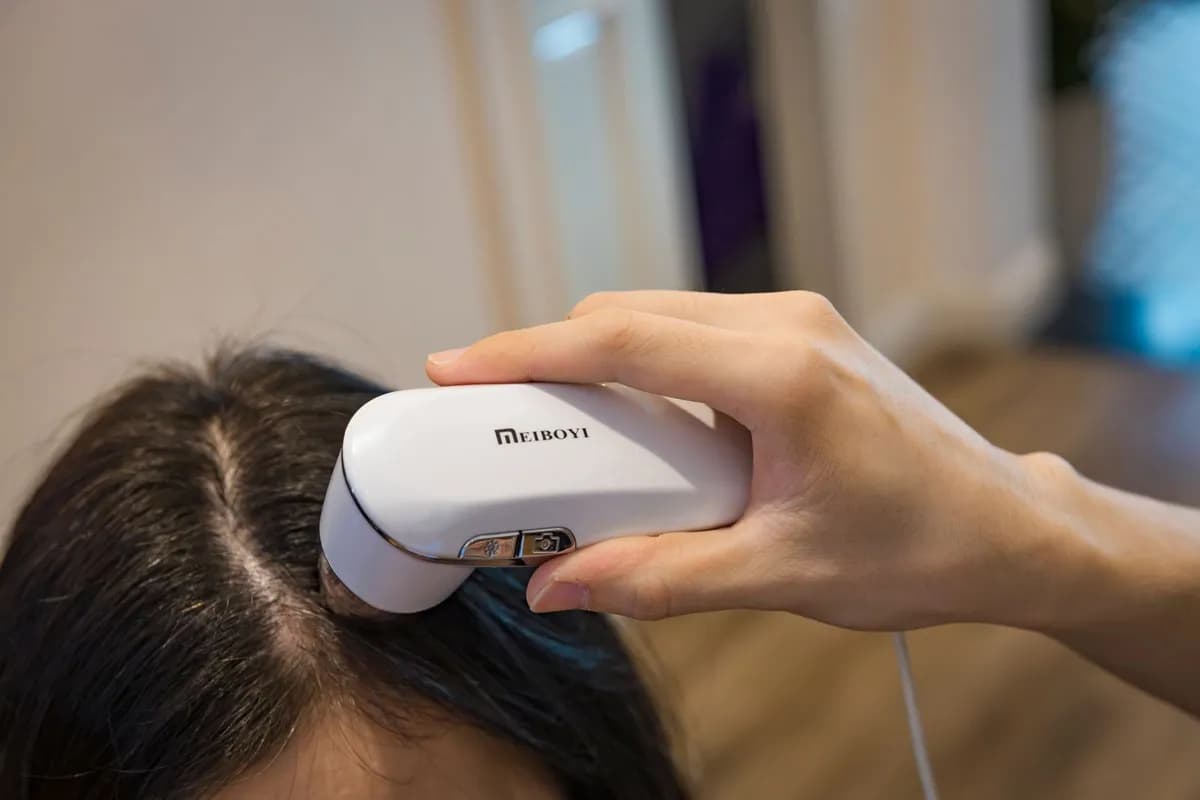
Photo by HONG SON / Pexels — Digital scalp examination allows clinicians to assess follicular activity that visual inspection alone cannot detect.
Norwood Stage V: The Band Narrows
At Stage V, the band of hair separating the frontal and crown recession zones has narrowed significantly. The two affected areas are approaching each other, and the overall density across the top of the scalp has reduced. The horseshoe pattern becomes more apparent when viewed from above.
Stage V represents a meaningful clinical boundary. Medical therapy may slow further progression and, in some cases, partially thicken remaining miniaturised hairs — but expectations must be calibrated accurately to what the current follicular state can deliver. A detailed clinical assessment remains essential at this stage because generalised photographs or visual inspection cannot adequately characterise the health of remaining follicles.
Norwood Stage VI: Frontal and Crown Zones Merge
At Stage VI, the midscalp band has been lost entirely or reduced to scattered, fine hairs that no longer constitute a meaningful cosmetic separation. The recession zones at the front and crown have merged into a single broad area of hair loss covering most of the top of the scalp. The remaining hair is confined to the sides and back of the head.
Stage VI is the first point on the scale at which non-surgical medical treatment is unlikely to achieve satisfactory cosmetic restoration when used alone. The follicles across the affected area have typically undergone advanced miniaturisation — many may be permanently dormant. Medical treatment may still provide some benefit in slowing loss at the margins or maintaining density in transitional zones, but this must be discussed honestly and specifically with a specialist rather than as a general expectation.
Norwood Stage VII: The Horseshoe Fringe
Stage VII is the most advanced classification on the standard scale. Only a narrow band of hair remains around the sides and back of the scalp — the occipital and temporal regions that are androgen-insensitive and therefore largely unaffected by DHT. The crown and entire top of the scalp have no terminal hair.
At Stage VII, the primary clinical discussion typically shifts away from medical hair loss therapy and toward surgical assessment (hair transplantation) or acceptance-focused approaches. The occipital donor hair that remains is frequently used as graft material for transplant procedures, which is why accurate staging at this point matters practically for what options remain viable.
Which Norwood Stages Are Best Suited to Non-Surgical Treatment?
The short answer, based on the clinical evidence: Norwood I through IV, with the most reliable outcomes in Norwood II through IIIA and IIIA Vertex.
The underlying reason is biological. Follicular miniaturisation is a progressive process, not a binary one. At earlier stages, follicles have typically undergone partial miniaturisation — they produce thinner, shorter hair shafts, but they remain metabolically active. Finasteride reduces the DHT stimulus that drives miniaturisation; minoxidil prolongs the anagen phase and increases follicular size. Both medications may work best when there is still meaningful follicular activity to preserve and stimulate.
Clinical studies indicate that finasteride registration trials — primarily conducted in men with Norwood II through IV vertex loss — showed stabilisation in up to 83% of men at the crown at two years, with visible regrowth in approximately 61–66% of vertex cases (Finasteride: a systematic review and meta-analysis). These figures are derived from men at earlier stages. The evidence base for men at Stage V, VI, or VII is substantially thinner, and clinical consensus generally does not support expecting comparable outcomes at these stages from medical therapy alone.
Similarly, evidence suggests topical minoxidil can be effective at maintaining and increasing hair density in men with androgenetic alopecia at earlier Norwood stages (Topical Minoxidil: A Systematic Review). Results may vary for each individual based on their stage of loss and underlying follicular activity.
For patients at Norwood IV who are weighing their options, early, consistent treatment remains a clinically defensible strategy — particularly when imaging confirms that follicular activity is still present in the affected zones. The critical point is accurate assessment before committing to a treatment plan.
For those whose pattern places them closer to Norwood V or beyond, an honest specialist consultation is more valuable than false optimism. A clinician who can clearly explain which follicles are still responsive — and which are not — is providing genuinely useful information, not a discouraging one.
Understanding how male pattern baldness progresses at each stage helps clarify why staging is not merely academic — it is the clinical foundation on which realistic treatment conversations are built.
The Problem With Self-Staging From a Mirror
Almost every patient who arrives at a hair loss clinic has already attempted to assess their own Norwood stage. The process typically involves a phone camera, a second mirror, and a series of overhead photographs taken in varying lighting conditions. The result is usually either reassuring or alarming — and frequently inaccurate in either direction.
There are several reasons why photographic self-assessment is an unreliable staging tool.
Focal length distortion. Smartphone cameras at close range introduce significant perspective distortion, making the crown appear wider — and therefore more affected — than it is. The same scalp photographed at arm's length and with a longer focal length camera lens can look meaningfully different.
Lighting inconsistency. Overhead lighting dramatically emphasises thinning by creating shadows in areas of reduced density. A man who appears Norwood IV under harsh bathroom lighting may present as Norwood III under diffuse natural light. Neither provides an accurate measure of actual follicular density.
No subsurface information. Visual inspection — whether in a mirror or a photograph — reveals only the cosmetic surface of hair loss. It cannot distinguish between a follicle that has permanently miniaturised and one that is temporarily dormant but biologically recoverable. Two scalps that look identical on a photograph may have very different underlying follicular profiles, with very different treatment prognoses as a result.
The emotional bias problem. Research on self-assessment accuracy in medical contexts consistently shows that patients tend to either underestimate or overestimate the severity of their own condition, depending on psychological factors. Men who have recently become aware of their hair loss often overestimate severity. Men who have been gradually habituating to it over years often underestimate how far it has progressed.
The standard clinical tool for addressing all of these limitations is digital trichoscopy — a magnified scalp imaging technique that allows a clinician to directly examine follicular density, hair shaft diameter, and the proportion of active versus miniaturised follicles across different zones of the scalp. When combined with the Norwood classification, this gives a complete clinical picture: not just the cosmetic pattern, but the biological substrate beneath it.
Clinical Staging at Carisma Hair Clinic, Malta
At Carisma Hair Clinic in St Julian's, every initial patient assessment includes scalp imaging and density mapping conducted by Dr. Giovanni Scornavacca. The imaging process places each patient precisely on the Norwood scale — not through visual approximation, but through direct measurement of follicular density, hair shaft calibre, and the ratio of terminal to vellus hairs across the affected zones.
The reason this matters clinically is straightforward. The Norwood stage determines the treatment protocol, the expected outcome range, and whether the Hair Reset Protocol can genuinely deliver measurable benefit for that patient. A patient who self-presents as "probably a Norwood III" may, on imaging, have active follicular populations across the crown that make them an excellent candidate for combination therapy with a strong density prognosis. The same patient might, alternatively, show a pattern of follicular dropout that changes the realistic expectation of the protocol — and the clinically honest conversation that needs to happen before treatment begins.
The difference between "I think I'm a Norwood III" and "imaging confirms Norwood IIIA with a high proportion of active follicles in the crown" is not merely semantic. It is the difference between a treatment plan built on assumption and one built on clinical data.
Carisma Hair Clinic accepts a maximum of 12 patients per month into the Hair Reset Protocol — not as a marketing device, but because this is the patient volume at which Dr. Scornavacca can personally oversee assessment, staging, and ongoing progress monitoring to the standard that produces consistent, documented outcomes.
For patients who are not candidates for the Hair Reset Protocol based on their Norwood staging — typically those presenting at Stage VI or VII without sufficient remaining follicular activity — Dr. Scornavacca will explain what realistic options exist, which may include discussion of surgical referral or maintenance approaches for the hair that remains.
For those whose receding hairline or crown concerns require a treatment approach tailored to their specific Norwood stage, the consultation is the place where that conversation begins — with clinical data, not assumptions.
Frequently Asked Questions About Norwood Scale Malta
What is the Norwood scale and what does it measure?
The Norwood scale is the internationally recognised clinical classification system for male androgenetic alopecia. It divides male pattern hair loss into seven stages based on the location and extent of recession at the temples, frontal hairline, and crown of the scalp. Originally developed by Dr. James Hamilton in 1951 and revised by Dr. O'Tar Norwood in 1975, it is used by hair loss specialists worldwide to standardise diagnosis, guide treatment decisions, and communicate about prognosis. The scale does not measure the speed of hair loss or the biological activity of remaining follicles — additional diagnostic tools such as scalp imaging are required for that assessment.
Which Norwood stage is best suited to non-surgical hair loss treatment?
Clinical evidence most strongly supports non-surgical medical treatment — including finasteride and minoxidil — for men at Norwood Stages I through IV. At these stages, most follicles retain some biological activity and can respond to treatment with stabilisation or regrowth. The registration trials for finasteride, which showed stabilisation in up to 83% of men at the crown at two years, were primarily conducted in men with vertex loss at Norwood II through IV. Men at Stage V or beyond may still benefit from treatment in certain respects, but the expected outcomes differ and should be discussed individually with a specialist following clinical imaging. Results may vary for each individual.
Can I accurately determine my own Norwood stage at home?
Self-assessment using photographs and mirrors provides a useful general impression but is not reliable for accurate clinical staging. Smartphone cameras introduce perspective distortion, lighting conditions create misleading shadows, and visual inspection cannot reveal the subsurface follicular activity that determines treatment prognosis. Two scalps that look identical in photographs may have very different biological profiles. Clinical trichoscopy — magnified scalp imaging — is the standard tool for accurate staging and is included in the initial consultation at Carisma Hair Clinic Malta.
Does Norwood stage affect which treatment will work for me?
Yes, meaningfully. The Norwood stage influences both the treatment approach and the realistic outcome range. Men at earlier stages typically have more biologically active follicles remaining, which may respond better to DHT-blocking therapy (finasteride) and follicular stimulation (minoxidil). The location of hair loss — frontal recession versus vertex thinning — also affects which formulations and application zones are most appropriate. Evidence suggests the crown typically responds better to finasteride than the frontal hairline, for example. Staging also determines whether the 90-day Hair Reset Protocol is an appropriate intervention or whether a different clinical approach is indicated.
What options are available if I am Norwood Stage V, VI, or VII?
For men at more advanced stages of hair loss, non-surgical medical therapy is unlikely to achieve satisfactory cosmetic restoration across the affected area, as the majority of follicles in the central scalp have typically undergone permanent miniaturisation. Options at these stages typically include surgical hair transplantation — using androgen-resistant occipital and temporal donor hair — or cosmetic approaches to optimise the appearance of remaining hair. Medical therapy may still be appropriate for slowing further progression at the margins or maintaining density in transitional zones. A consultation with a specialist who can assess remaining follicular activity through clinical imaging will provide the most accurate picture of what options remain genuinely viable. Results may vary for each individual.
How much does a Norwood scale hair loss consultation cost in Malta?
The initial hair loss consultation at Carisma Hair Clinic — which includes full Norwood staging, digital scalp imaging, and density mapping — is offered free of charge. This allows Dr. Scornavacca to provide an accurate clinical assessment before any treatment discussion takes place. Costs for treatment protocols are discussed transparently at the consultation, once staging has confirmed which approach is most appropriate for your pattern of loss. There are no obligations attached to the initial assessment.
Is hair loss treatment safe, and are there side effects I should know about?
Medical treatments for androgenetic alopecia — including finasteride and minoxidil — have well-characterised safety profiles established through decades of clinical use and large-scale registration trials. Finasteride is a prescription medication and should only be initiated following medical assessment; potential side effects, including rare hormonal effects, are discussed at consultation. Minoxidil is available over-the-counter in some formulations, though its use is typically optimised under clinical guidance. All treatment protocols at Carisma Hair Clinic are medically supervised by Dr. Scornavacca, and no treatment is initiated without a thorough clinical review of individual suitability.
Ready to Take Control of Your Hair Loss?
If you've been researching your options and want a clinical assessment rather than another generic recommendation, Carisma Hair Clinic offers a comprehensive diagnostic consultation — scalp imaging, density mapping, and a personalised protocol designed around your specific pattern of loss.
→ Book Your Free Hair Loss Consultation
Dr. Giovanni Scornavacca and the team at Carisma Hair Clinic are available at our St Julian's clinic.
About the Author
Dr. Giovanni Scornavacca is a hair restoration specialist with over 20 years of clinical experience, with advanced training at universities in Rome and Bologna. He leads the Hair Reset Protocol at Carisma Hair Clinic — Malta's most complete non-surgical hair regrowth programme. Dr. Scornavacca specialises in diagnosing and treating androgenetic alopecia, telogen effluvium, and complex hair loss presentations using a combination of PRP, exosome therapy, and prescription protocols tailored to each patient.
Medical Disclaimer: This article is for informational purposes only and does not constitute medical advice, diagnosis, or treatment recommendations. Results may vary for each individual. Always consult a qualified healthcare professional before starting any hair loss treatment. Dr. Giovanni Scornavacca and Carisma Hair Clinic are available for clinical consultation at our St Julian's, Malta clinic.
Written and reviewed by Dr. Giovanni Scornavacca, Carisma Hair Clinic. Published: 26 June 2026.
Ready to Take Action?
Book a free online consultation with Nurse Leticia to talk through your hair loss, then see Dr. Giovanni Scornavacca at the clinic for a personalised assessment and treatment plan.
Book a Free Consultation